
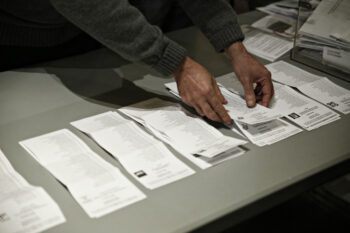
For years, conservatives have watched election nights stretch into election weeks — apparent winners on Tuesday night becoming apparent losers by Friday as mail-in ballots trickled in from across the country, changing results with each update. Justice Samuel Alito put a name to the frustration Monday during oral arguments in Watson v. Republican National Committee: “We don’t have Election Day anymore. We have election month, or we have election months.”
The case before the court is straightforward on its face. Mississippi has a law allowing mail-in ballots to be counted if they are postmarked by Election Day but arrive up to five business days afterward. The Republican National Committee, backed by the Trump administration, argues that federal law — specifically statutes from 1845 and 1872 establishing a uniform Election Day — requires ballots to be received by Election Day, not merely mailed by it. Fourteen states plus Washington, D.C. have similar grace period laws. In the 2024 election alone, at least 750,000 ballots were counted under these provisions.
A ruling is expected by late June or early July — potentially in time to affect how the 2026 midterms are conducted.
The court’s conservative bloc made their skepticism of grace period laws clear from the opening minutes of argument.
Alito raised the concern that late-arriving ballots could create “an appearance of fraud by radically changing the trajectory of an election.” His observation that we no longer functionally have a single Election Day was not an off-hand comment — it was a direct challenge to the legal framework that grace period defenders have relied on. Justice Kavanaugh echoed the point, asking whether the court should be thinking about “confidence in the election process” when results can shift dramatically after Election Night as late ballots arrive.
Justice Gorsuch raised a more specific concern: if ballots can legally arrive days after Election Day, what prevents a voter from effectively acting on post-Election Day information — changing the practical outcome of an election based on events that occurred after polls closed? The RNC’s attorney Paul Clement argued that historically, casting a ballot and delivering it occurred simultaneously — a voter handed their ballot directly to an official. The entire concept of a ballot arriving days later is a modern invention that federal law never contemplated.
If the conservative majority rules in favor of the RNC, the practical consequences are significant and immediate. Grace period laws in 14 states plus D.C. would be struck down or rendered unenforceable for federal elections. The 750,000-plus ballots that were counted under those provisions in 2024 would not have been counted under the new standard. States would face a compliance deadline ahead of November 2026 with voters who followed the old rules potentially finding their ballots disqualified.
Chief Justice Roberts and Justice Barrett — the court’s swing votes on many election cases — asked pointed questions about how far a ruling might reach. Barrett specifically raised the concern that requiring all ballots to be received by Election Day could, depending on the court’s reasoning, raise questions about early voting in some states. That concern will likely shape how narrowly or broadly the majority writes its opinion, if it rules for the RNC.
Democrats and their allies frame this case as an attack on voting rights. The more accurate framing is simpler: federal law says Election Day is a specific Tuesday in November. The question is whether “Election Day” means the day votes are cast or the day votes are received. For 130 years after the 1872 statute was enacted, those two things were the same. They are no longer the same, and that gap is what this case is about.
Schumer called the SAVE Act “voter suppression.” Kagan warned about where the court is “going to end up.” But the conservative argument does not require any theory of suppression or bad faith — it requires only that federal law means what it says, and that a ballot postmarked Tuesday but received Friday is a ballot that arrived after Election Day.
The ruling comes in June. The midterms are in November. The timing is not a coincidence.