
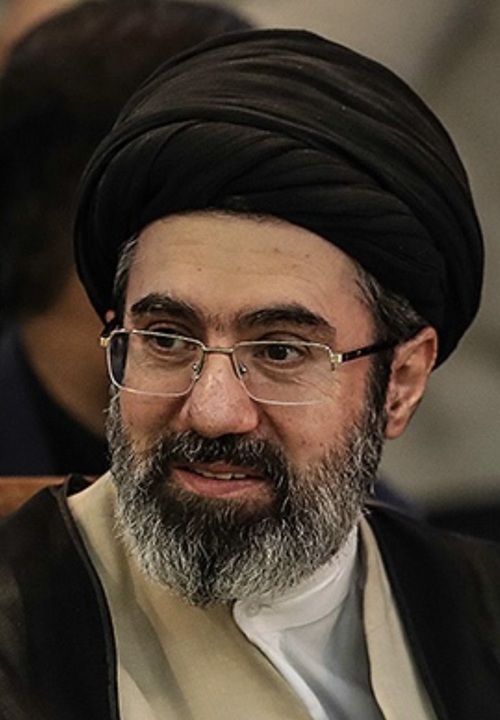
Photo courtesy of Student News Agency SNN.ir
Iran founded its Islamic Republic in 1979 on one core promise: no more kings. No more dynasties. No more hereditary power. The revolution was specifically against the Shah’s bloodline rule.
Forty-seven years later, the IRGC just installed Ayatollah Khamenei’s son as Supreme Leader. (They didn’t mention anything about that being ironic. We’re noting it anyway.)
Meet Mojtaba Khamenei, 56, Iran’s new Supreme Leader — a man most Iranians have never seen in public, who has never held elected office, never given a press interview, and who was elevated to the highest position in the Islamic Republic while wounded from the same strikes that killed his father, his wife, and his mother. His credentials for the job: he’s the right son.
Here’s what we actually know about Mojtaba, because the mainstream press is treating him like a mystery. He is not a mystery. He joined the IRGC at 17 during the Iran-Iraq War. He studied theology at Qom Seminary under Mohammad-Taqi Mesbah-Yazdi — the ideological architect of Iran’s most extreme ultraconservative movement. He holds the clerical rank of hojatoleslam — notably below the ayatollah rank traditionally required to lead the Islamic Republic. The IRGC installed him anyway.
His most significant role before this week: personally running the crackdown on the 2009 Green Movement. When millions of Iranians poured into the streets demanding reform, national security meetings moved to the Supreme Leader’s office — and Mojtaba ran them. He effectively commanded the Basij. He bears direct responsibility for suppressing the 2017, 2019, and 2022 protest waves as well.
His father’s will reportedly rejected him as successor. The IRGC overruled the will.
The IRGC applied what the Times of Israel describes as “psychological and political pressure” on Assembly of Experts members right up until the online selection session began — phone calls, in-person visits, the works. The vote was approximately 85-90% in Mojtaba’s favor. This is what IRGC-managed democracy looks like in 2026.
Trump called him a “lightweight” before the selection. After it, Trump said Mojtaba “isn’t going to last long” without U.S. approval. Lindsey Graham was more specific: “Not the change we’re looking for. It’s just a matter of time before he meets the same fate as that of his father.” Israel’s Foreign Ministry noted his “hands are already stained with the bloodshed that defined his father’s rule.”
On the streets of Iranian cities, residents chanted “Death to Mojtaba” from apartment windows.
These are not traditionally the sounds of a smooth succession.
Analysts believe he is harder line on nuclear weapons than his father — who at least maintained a religious fatwa against building a bomb. Mojtaba reportedly opposed the fatwa. Fox News: “His father on steroids.”
The most important structural fact about Mojtaba’s selection isn’t his ideology — it’s who he owes. He has no decades of built public legitimacy. No domestic political constituency. No theological credentials above what’s traditionally required. He owes his position entirely to IRGC commanders who applied pressure on his behalf and delivered the vote. That means the IRGC doesn’t just have influence over Iran’s Supreme Leader — they effectively installed and control him. Iran has functionally become a military junta with clerical branding.
That changes the decision-making calculus on everything. When Ali Khamenei ran Iran, the IRGC was a powerful but subordinate force within a clerical-led system. Under Mojtaba, IRGC commanders are the power behind the throne. Every decision about nuclear weapons, proxy wars, and negotiations flows through Revolutionary Guard generals first. The entity the United States designated as a foreign terrorist organization is now the de facto government of Iran.
Iran’s Islamic Revolutionary Guard Corps just installed the most nuclear-aggressive, most domestically brutal, most personally revenge-motivated Supreme Leader in the country’s history — operating behind a perimeter of black-clad kill squads while wounded, while grieving a wife, a mother, and reportedly a son.
Here’s the variable nobody is tracking: Mojtaba was wounded in the same strikes that killed his father. Iran initially denied it, then confirmed it. His exact condition is still unclear — he did not attend his own appointment ceremony. Officials held up a framed photo instead.
Mark my words: whether Mojtaba survives physically is the single biggest variable in what comes next. If he dies or is incapacitated, the IRGC faces an immediate succession crisis with no clear alternative and a room full of generals who all want the power. That scenario accelerates regime collapse faster than any military campaign. If he survives and consolidates, Iran is a military junta led by an IRGC puppet with personal revenge as his primary motivation and no religious prohibition against nuclear weapons.
Neither scenario ends quietly.