When CNN starts sounding the alarm about Democrats drifting too far left, you know the numbers must be bad.
Not “Republican spin” bad.
Not “conservative talk radio” bad.
Bad enough that a network routinely accused of leaning left had no choice but to put the data on the screen and let it speak for itself.
And the data is brutal.
CNN senior data analyst Harry Enten recently revealed that 58 percent of Americans now say the Democrat Party is “too liberal.” Let that sink in. Nearly six in ten Americans believe the party has moved beyond their comfort zone.
The trend line makes it worse. In 2013, that number was 48 percent. In 1996, when Bill Clinton was president and Democrats still campaigned as moderates, it was just 42 percent.
The country didn’t suddenly lurch right. The party moved left.
That’s not speculation. It’s arithmetic.
The poll confirms what millions of former Democrats have been saying for years: “I didn’t leave the Democrat Party, the Democrat Party left me.”
And this isn’t some minor branding problem. As Nicole Russell wrote in USA Today, “It’s a problem for Democrats that a majority of the general electorate views the party as ideologically too far to the left. The implication for the midterm elections could be huge. If this perception persists, Democrats may still struggle in 2026 and 2028 in suburban swing districts, Rust Belt states and moderate-leaning battleground states that Trump swept in 2024.”
Enten put it plainly: “The Democrats are moving to the left, the far left is gaining power, and there could be some electoral repercussions because what we see right now is voters – the clear majority – say that they are too liberal.”
But here’s the part that should terrify Democrat strategists: the base isn’t moderating.
In 1999, according to Gallup, 26 percent of Democrats identified as “conservative,” while just five percent identified as “very liberal.” Today, those numbers have flipped. 21 percent of Democrats now identify as “very liberal,” while only eight percent say they are conservative.
That’s not drift. That’s transformation.
And it goes even further. Thirty-three percent of Democrats now say they are “democratic socialists.” Among Democrats under 35, that figure jumps to 42 percent.
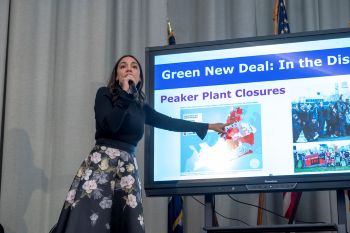
In other words, Bernie Sanders and Alexandria Ocasio-Cortez aren’t fringe voices anymore. As Enten said, “[The] far left has gained considerably in power. What happened in New York City is not an aberration.”
This leftward surge is reshaping primaries across the country. Progressive activist Analilia Mejia defeated former Democrat Rep. Tom Malinowski in a special primary, despite initially being viewed as a long-shot. Backed by Sanders and Ocasio-Cortez, she won. Enten said the result “speaks to a larger point” about the shrinking influence of moderates inside the party.
Even self-described moderates are adjusting. Virginia Governor Abigail Spanberger reversed an executive order requiring cooperation with federal immigration authorities and shifted positions on redistricting in ways that align more closely with the progressive wing.
The message is clear: if you want power inside today’s Democrat Party, you move left. The voters? They’re another story.
This should be a wake-up call. A flashing red light. A moment of reckoning.
But history suggests otherwise. The numbers show the party has been moving left for decades — regardless of what general election voters say they want.
And that’s the collision course heading into 2026 and beyond.
Because when 58 percent of Americans say you’ve gone too far, you can ignore them for only so long before they answer back at the ballot box.